When people think of Spiti Valley, they usually picture brown moonscapes, dusty dirt tracks, and summer road trips. In winter, that landscape undergoes a total metamorphosis. The brown soil vanishes under three feet of powder snow, waterfalls turn into vertical blue-ice sculptures, and the entire high-altitude desert transforms into White Spiti.
It is raw, quiet, and shockingly beautiful. There are no tourist traffic jams or noisy souvenir stalls. The only sounds are the hum of prayer flags flapping in the dry breeze and the crunch of fresh snow under your boots.
Every winter, our team leads small groups into this Himalayan wilderness on our Spiti Winter Expedition. If you are wondering whether you can brave the sub-zero temperatures and what you will actually witness with your own eyes, here is your preview of the expedition.
- Region
- Spiti Valley & Kinnaur, Himachal Pradesh
- Altitude
- 3,280 m to 4,587 m (Tabo to Komic)
- Difficulty
- Moderate (sub-zero winter road expedition in 4x4)
- Gateway Hub
- Shimla or Chandigarh
- Expedition Duration
- 7 Days / 6 Nights
- Operating Season
- November–March
- Key Highlights
- Key Gompa, Chicham Bridge, Langza Buddha, Hikkim Post Office, Tabo
1. The Gateway Run: Kinnaur Gorges and Khab Sangam
Entering Spiti in winter is an adventure in itself. Because the high northern passes of Kunzum and Rohtang stay buried under ten feet of snow, our winter Spiti route takes the legendary Hindustan-Tibet Highway (NH 05) through Kinnaur.
As the road snakes higher past Jeori and Tapri, the pine slopes give way to sheer vertical rock walls carved by the Sutlej River. You pass dramatic overhanging cliffs and quiet settlements like Sangla and Kalpa, where the Kinner Kailash massif sparkles in fresh morning snow.
At Khab, you witness one of the most striking river confluences in the Himalayas: the green waters of the Sutlej meeting the icy turquoise Spiti River. By the time we cross the bridge into the Spiti district, the air turns crisp and bone-dry, and the first snow fields begin to line the highway.

2. Tabo Monastery: A Millennium of Intact Mud Art
Founded in 996 AD by the Buddhist king Yeshe-Ö, Tabo Monastery is the oldest continuously operating Buddhist enclave in India and the Himalayas. While summer visitors often rush through, winter Tabo is remarkably peaceful.
From the outside, Tabo looks like an unassuming mud compound blending into the scree slopes. Step inside the dimly lit Assembly Hall, and you enter a museum of 10th-century stucco sculptures and wall frescoes.
Monks wrapped in maroon woolen robes pad softly across wooden floorboards, lighting butter lamps that scent the chilly air. Because winter crowds are non-existent, our group gets to spend quiet time absorbing murals that have survived untouched for over a thousand years.
3. Dhankar: The Cliff-Hanger Above Two Rivers
Perched dramatically on a knife-edge ridge at nearly 3,900 metres, Dhankar Monastery looks like something out of a fantasy novel. In centuries past, it served as both a spiritual retreat and a fortified lookout post for the rulers of Spiti.
In winter, the pinnacles of wind-eroded mud and sandstone around the monastery are tipped with snow. From the monastery terrace, you look straight down into the valley floor where the Pin and Spiti rivers merge.
Nearby in the Lingti Valley, we make a roadside stop to view frozen cascades. Giant mountain streams that rage in July freeze completely solid mid-fall, hanging like massive cathedral organs of translucent turquoise ice.

4. Key Monastery: The Snow Fortress of Spiti
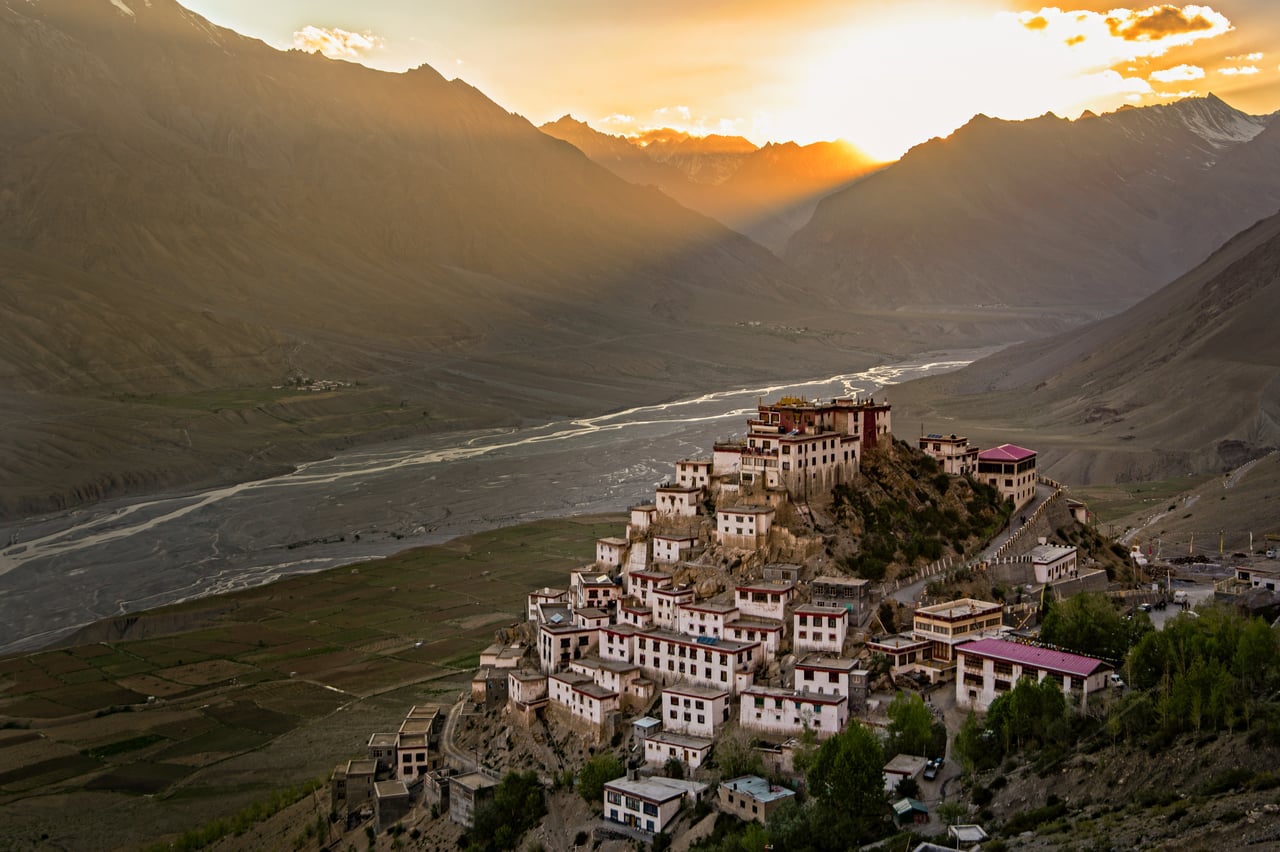
Key (Kye) Gompa is Spiti’s signature landmark. Sitting on a conical hill at 4,166 metres, its whitewashed buildings stack atop one another like a miniature medieval city against the backdrop of jagged peaks.
Seeing Key in summer is memorable, but seeing it wrapped in winter snow is unforgettable. The entire valley beneath the monastery is a blinding sheet of white, with the blue ribbon of the Spiti River threading through the ice.
We climb up through the monastery courtyards to the upper prayer halls. Here, young lamas greet us with warm smiles and invite our crew into the heated monastery kitchen for hot cups of butter tea. Standing on the rooftop with prayer flags whipping in the crisp mountain breeze is a moment you will carry home forever.

Want to Experience White Spiti This Winter?
We run curated 7-day winter expeditions with heated homestays, local 4x4 drivers, and experienced trip captains. Chat with us to check upcoming batch dates and seat availability.
You can see how we structure each day across Sangla, Tabo, Kaza, and the high passes on the Spiti Winter Expedition itinerary page.
5. Chicham Bridge: Walking Over a 150-Metre Abyss
A short drive past Kibber village brings you to Chicham Bridge, officially celebrated as the highest suspension bridge in Asia at an altitude of 4,145 metres (13,596 feet).
The bridge spans a staggering 150-metre (nearly 500 feet) deep canyon known as the Samba Lamba Nallah. Before this engineering feat was completed in 2017, villagers had to cross the gorge in a perilous hand-pulled cable trolley.
Walking across the metal deck in winter is an exhilarating adrenaline rush. Look down through the railing, and you will see sheer vertical rock faces decorated with giant icicles pointing toward the frozen riverbed far below.

6. The High Villages: Langza, Komic, and Hikkim
One of the crowning days of our expedition is the high-village loop, ascending to some of the highest human settlements on the planet.
First comes Langza at 4,400 metres. As you pull into the village, you are greeted by the famous golden Buddha statue seated calmly on an open ridge. Directly behind the statue rises the snow-blanketed bulk of Chau Chau Kang Nilda (6,303 m). Millions of years ago, this entire plateau was the floor of the Tethys Ocean, and locals still find marine fossils (ammonites) embedded in the soil.
Next is Komic, sitting at 4,587 metres (15,049 ft), recognized as one of the highest motorable villages in the world. We stop outside the 14th-century Tangyud Monastery and snap a fun photo outside the iconic “World’s Highest Restaurant” board over a steaming cup of ginger lemon tea.
The loop concludes at Hikkim (4,440 m), home to the highest operational post office on Earth. We hand everyone stamped postcards, write notes to family and friends back home, and drop them straight into the world-famous red letterbox. Getting a postcard stamped with the official Hikkim postmark weeks later is one of the most delightful souvenirs of any Himalayan journey.

7. The Living Experience: Bukhari Warmth and Star-Dusted Nights
What makes travelling on our Spiti Winter Expedition truly memorable is not just the scenery, but how you live inside it.
Winter in Spiti is an exercise in authentic mountain culture. Hotels in Kaza shut down because their water pipes freeze solid. Instead, we stay in traditional family-run Spitian homestays. The thick mud-and-stone walls provide remarkable natural insulation against the bitter wind outside.
Every evening, our entire group gathers in the central dining room around the bukhari, a wood-and-charcoal-burning iron stove. As the stove glows warm, hosts bring out steaming bowls of homemade thukpa, fresh momos, tingmo bread, and spiced chai. Laughter flows freely, stories are swapped, and you realize you have made genuine friends for life.
Later at night, step outside into the courtyard for two minutes. The crystal-clear, bone-dry winter air reveals the Milky Way stretching across the sky with unmatched brilliance. Shooting stars slice across the silhouette of the snow peaks in total, sacred silence.
Practical Essentials for White Spiti
To enjoy winter in the high Himalayas, you need clear expectations and the right preparation. Here are the three non-negotiables:
- Layering over bulk: You do not need one giant, heavy jacket. You need a 4-layer system: thermal base layer (merino wool or synthetic), fleece mid-layer, warm down jacket, and a windproof/waterproof outer shell. Add woollen socks, insulated waterproof boots, fleece gloves, and dark UV sunglasses.
- The Dry Toilet reality: Water freezes instantly in high-altitude plumbing. Spiti survives winter through traditional dry compost toilets with sand and ash. They are clean, completely odorless, and environmentally responsible. Our hosts provide plentiful buckets of boiling water each morning for personal hygiene.
- Slow Acclimatization: We do not rush you up the mountain. By staying at Sangla (~2,700 m) on Night 1 and Tabo (~3,280 m) on Night 2, your lungs and body adapt naturally before we sleep in Kaza (~3,650 m). Drink plenty of water and warm garlic soup, avoid alcohol during the climb, and let your body set the pace.
When you travel with us on the Spiti Winter Expedition, your transport is handled by local Spitian drivers who have spent decades maneuvering 4x4 vehicles across snowdrifts and black ice. Your trip captain monitors pulse and oxygen levels daily, and every meal and homestay arrangement is dialed in.
All you have to do is show up, wrap your fingers around a warm cup of chai, and let White Spiti take your breath away.
Explore the full 7-day Spiti Winter Expedition itinerary & upcoming dates →


