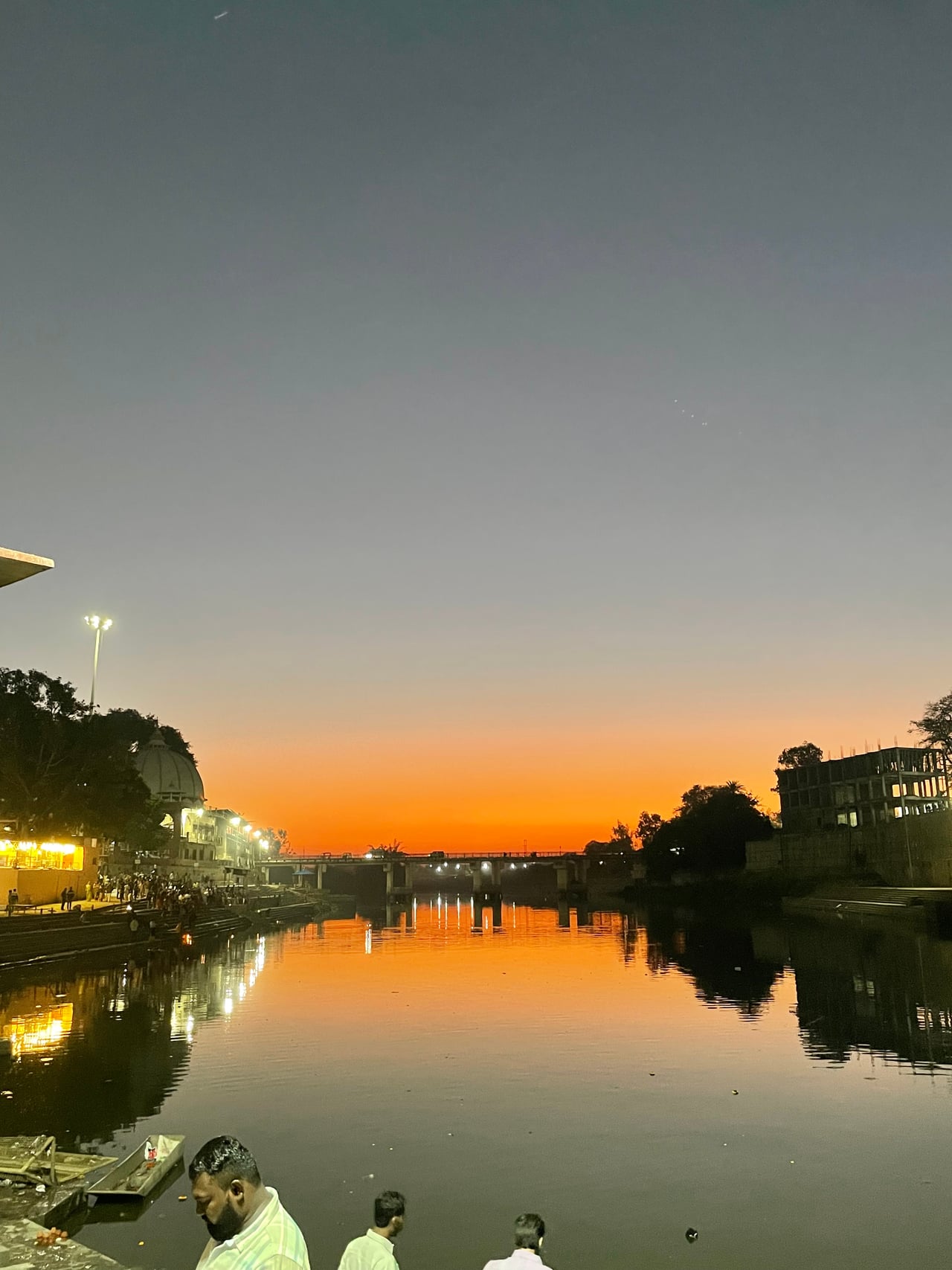
The queue at Mahakaleshwar is one version of Ujjain. The riverbank at Ram Ghat in the hour before the aarti is another. Most visitors only see the first one.
This is the third post in the Ujjain series. Post one covers crowds, dress code, and the Omkareshwar day trip. Post two covers the Bhasma Aarti booking and what to expect inside. This post is about the sites that need no booking, no pre-dawn alarm, and no weeks of advance planning. They are also, for many of the people who travel with us, the parts of Ujjain they carry home longest.
- Sites covered
- Ram Ghat · Kaal Bhairav · Harsiddhi Mata
- Booking required
- None. All three are free, open entry.
- Ram Ghat aarti
- Tied to sunset: roughly 6:00–7:00 PM by season. Arrive 30–45 min early.
- Harsiddhi distance
- 600 m from Mahakaleshwar. Walkable.
- Kaal Bhairav distance
- 6–7 km from Mahakaleshwar. Auto-rickshaw needed.
- Entry fees
- Free at all three sites
Ram Ghat: The Aarti on the Kshipra
Ram Ghat is the oldest bathing ghat in Ujjain, and it earns that standing twice over. The first layer is mythological: this is where Rama performed the pind daan for his father Dasharatha during his forest exile. The second is cosmological: drops of amrit are said to have fallen here when Garuda carried the nectar away from the gods, which is why Ujjain holds one of only four Kumbh Mela sites on the planet. The next Simhastha is due in 2028.
In the middle of the day the ghat is steady but not overwhelming: pilgrims bathing, priests at their platforms, flower sellers along the steps. Come back in the hour before sunset and the geometry shifts entirely.
The Sandhya Aarti begins as the sun drops toward the horizon and runs for approximately one hour. Priests stand at the water’s edge on low platforms holding large multi-tiered brass lamps. Bells ring, cymbals keep time, conch shells blow at intervals. The chanting builds in cycles, the crowd joins the call-and-response, and at peak moments several hundred people are responding together across the water. Devotees release small earthen diyas, marigold garlands, and petals into the Kshipra, so the river runs with light through the final stretch of the aarti.
Timing is seasonal: roughly 7:00 PM in the height of summer and 6:00 PM in winter, with 6:30 PM as a reliable mid-season estimate. Arrive 30 to 45 minutes before sunset, find a place on the lower steps, and let the ghat fill around you. There is no ticketed section, no restricted gallery. The better spots go to those who arrive early and sit close to the water.

One detail most visitors walk straight past: on the side of the ghat stands a small illuminated shrine to Dharmraj and Chitragupt, the keeper of human deeds in Hindu tradition. It is lit at night and worth a quiet five minutes before or after the aarti.

Photography is generally permitted on the ghat itself. Check posted rules before photographing inside any of the smaller shrines at the ghat’s edge.
Kaal Bhairav: Ujjain’s Protector
Every city in the Shaiva tradition has a Bhairava, the fierce guardian who watches the perimeter and holds the cosmic order in place. Ujjain’s is Kaal Bhairav, worshipped here as the Kotwal: literally, the city’s chief of police. The belief is that no soul can enter or leave Ujjain without his knowledge and permission. His temple sits 6 to 7 kilometres from Mahakaleshwar in the older Bhairavgarh quarter, and it draws a quieter, more deliberate kind of pilgrim. This part of Ujjain does not advertise itself.
The deity is a black stone face, dramatically carved, framed in silver and flowers. What brings most people to this specific temple, and what earns it a mention in almost every piece written about Ujjain, is the madira prasad: the liquor offering.
This is not a folk legend or a metaphor. Since April 2025, Madhya Pradesh has banned liquor sales across Ujjain’s old city, but Kaal Bhairav received an official government exemption: the offering continues uninterrupted, with liquor available only at a regulated counter inside the temple premises. A devotee purchases a small cup of spirit, the priest carries it to the deity’s lips, holds the cup to a carved slit in the stone, and within a short time the liquid has vanished. The mechanism has been debated for decades: porous basalt, capillary channels in the stone, evaporation in the enclosed chamber. Nothing has been definitively established. The ritual has continued without interruption for centuries. If alcohol is not your offering, flowers and coconut are entirely acceptable alternatives and the priest will not hesitate.

The temple’s history runs from the Skanda Purana through the Paramara dynasty, but the most vivid chapter is Maratha. After the Third Battle of Panipat in 1761, general Mahadaji Shinde pledged his pagri to Kaal Bhairav and vowed to restore Maratha power in North India. When he succeeded, he returned to the temple and rebuilt it. The deity still wears a Maratha-style pagri in his honour, and silver replicas of the turban remain a common offering at the shrine today.
Temple timings are 5:00 AM to 9:30 PM. The formal morning and evening aartis run from 7:00 to 8:00 AM and 6:00 to 7:00 PM respectively. The liquor offering happens throughout the day outside those windows; there is no single best time except to avoid the peak aarti hour if you want space at the sanctum.
Harsiddhi Mata: Fire Towers and a Fierce Goddess
Walk 600 metres from Mahakaleshwar’s eastern gate and you reach one of the 51 Shakti Peethas. In the tradition of the sacred sites where parts of Sati’s body fell after Vishnu used his Sudarshana Chakra to end her, Harsiddhi marks where her elbow landed. It is counted as the thirteenth peetha.
What stops you at the entrance is the courtyard. Two tall iron lamp towers, called deepstambha, rise from the stone, built during the Maratha period. Each holds more than 500 lamp holders, totalling over 1,100 across both towers. During Navratri (Chaitra in March/April and Sharad in September/October), all lamps are lit simultaneously: a column of fire visible across the city. The evening aarti lights the towers daily, though the full effect comes during the festival season. If you want to plan around the deepstambha, both Navratri windows are worth the extra timing effort.
Inside the sanctum, the main idol of Harsiddhi Devi is in deep vermilion form. Mahalakshmi stands to her right and Mahasaraswati to her left. A Shree Yantra is also enshrined in the complex. The atmosphere inside is concentrated rather than grand, consistent with Shakti Peetha temples generally.

The Vikramaditya connection is the oldest strand of the temple’s mythology. The legendary emperor is said to have been Harsiddhi’s most devoted worshipper and to have offered his own head to the goddess eleven times as the ultimate act of surrender, each time having it restored. The blessings she granted became the source of his legendary judgment and the court of scholars and poets, the Navaratnas, drawn to him. A small shrine at the site marks his connection to this spot.
Temple timings are 5:00 AM to 7:00 PM daily. It is one of the easiest Ujjain sites to build into a Mahakaleshwar morning: darshan done, ten-minute walk, and you are at a Shakti Peetha before the midday heat arrives.
How to Sequence These
Harsiddhi and Ram Ghat are both within walking distance of Mahakaleshwar (600 metres and 1 km respectively, with Ram Ghat connected by the Mahakal Lok Corridor). Kaal Bhairav is the exception, 6 to 7 kilometres into the Bhairavgarh quarter, requiring an auto-rickshaw or cab. The ride takes 10 to 15 minutes and costs around ₹100 to 150 one way.
Ujjain Temple Distance and Travel Time Chart
| Route | Exact Distance | Travel Mode | Travel Time | Cost / Notes |
|---|---|---|---|---|
| Ram Ghat to Harsiddhi Mata | ~600 metres | Walking | 7–10 minutes | Easy stroll through temple lanes |
| Mahakaleshwar to Ram Ghat | ~1 km | Walking / E-rickshaw | 10–12 minutes | Direct via Mahakal Lok corridor |
| Mahakaleshwar to Harsiddhi Mata | ~600 metres | Walking | 6–8 minutes | Straight road from Eastern Gate |
| Kaal Bhairav to Harsiddhi Mata | ~5.5 km | Auto-rickshaw / Taxi | 15–20 minutes | ₹100–150 auto fare |
| Ram Ghat to Kaal Bhairav | ~6 km | Auto-rickshaw / Taxi | 15–20 minutes | Along Bhairavgarh road |
A practical split across two days:
Day one: Mahakaleshwar darshan, then walk to Harsiddhi. Return toward Ram Ghat for the Sandhya Aarti and the floating diyas at dusk.
Day two: Kaal Bhairav by auto in the morning before the heat arrives. Return to Mahakal Lok in the afternoon. Omkareshwar is a full-day excursion that works best on day two or three; the trip tips post covers it in full.
One scheduling note: the Harsiddhi evening aarti and the Ram Ghat aarti run at the same time. On a two-night trip, prioritize Ram Ghat for the river experience on the first evening, then visit Harsiddhi on the second morning. The deepstambha is also lit during the morning aarti (7:00 to 8:00 AM), so you do not miss the towers by saving Harsiddhi for morning.
Come With Us
The 3-day Ujjain Darshan pilgrimage package covers every site in this guide. The three-day itinerary includes Ram Ghat for the evening aarti, Kaal Bhairav with the full liquor offering ritual, Harsiddhi Mata, the Mahakaleshwar circuit, Mahakal Lok, and the Omkareshwar excursion by private vehicle. The trip captain manages the auto logistics for Kaal Bhairav, the aarti timing at Ram Ghat, and every queue in between.
Three days, two nights, from ₹7,999. If you still have Bhasma Aarti questions before you book, the second post in this series has the full booking walkthrough.


